For many organizations, managing a shared vehicle fleet still relies on fixed locations, limited opening hours, and manual key handling. This was also the reality for King County in Seattle. With thousands of employees and a large service area, the existing system was increasingly reaching its limits.
By gradually modernizing its operations, King County transformed its motor pool into a fully automated, keyless solution with 24/7 access. The result: greater efficiency, increased flexibility, and improved fleet utilization.
The starting point: one location and fixed operating hours
King County’s central motor pool serves more than 800 employees with a shared fleet of 30 vehicles. Originally, these vehicles could only be picked up at a single garage located in downtown Seattle.
This created clear operational limitations. Employees had to plan their workday around the garage opening hours, which opened in the morning, closed during lunch, and shut down in the early afternoon. Outside these hours, there was no access to vehicles.
For an organization operating across an area of nearly 2,300 square miles (approx. 6,000 km²), these constraints had a significant impact. Field staff were unable to depart early enough to reach remote locations, while evening shift workers had no access at all. In addition, all coordination was handled through a single central point, resulting in delays and inefficiencies.
The first step: digitizing key management
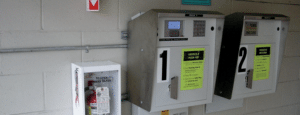 To address these limitations, King County began digitizing key management in 2007 by introducing electronic key lockers. Employees could retrieve vehicle keys using an access code, enabling access outside office hours.
While this was a clear improvement, new challenges emerged. Access codes were shared or lost, and reliance on network connectivity occasionally caused disruptions. In addition, physical infrastructure was still required at every location.
From keys to vehicle-based technology
In 2011, King County took the next step by integrating technology directly into the vehicles. In this phase, Invers hardware was used in the vehicles, connected to the WeGo platform for access, management, and monitoring. This enabled keyless access and provided better visibility into vehicle usage and location.
Because this solution did not depend on fixed infrastructure at each site, the fleet could be deployed more flexibly. Vehicles were made available across multiple locations beyond the central garage. What started as a pilot quickly expanded to a larger rollout.
The breakthrough: fully keyless and app-based mobility
The real transformation came in 2022, when King County transitioned to a fully cloud-based solution in combination with the WeGo platform.
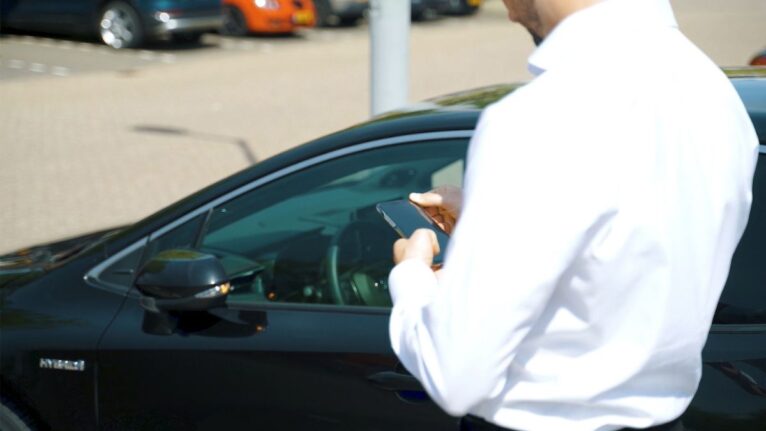
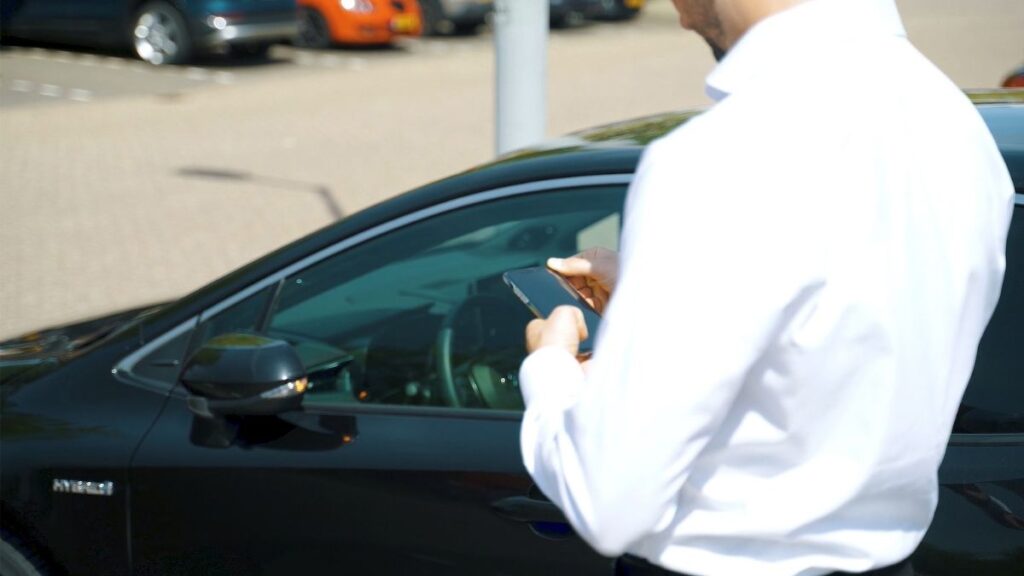
From that moment, the user experience changed fundamentally. Employees reserve vehicles via the app, walk to the car, and unlock it using Bluetooth. Keys, access codes, and physical handover points were completely removed from the process.
Because access is handled via Bluetooth directly between the smartphone and the vehicle, the system also works in locations without cellular reception, such as underground parking garages. In addition, every vehicle is linked to an active reservation, providing an extra layer of security and control.
What changed in practice?
24/7 vehicle access
The most immediate change was availability. Vehicles are now accessible 24/7, allowing employees to work more flexibly and without dependence on opening hours.
Expansion to multiple locations
With no need for staffed key points, King County expanded from one central garage to five locations. This allows vehicles to be positioned closer to users and operational demand.
Data-driven fleet optimization
All vehicles are equipped with technology that provides real-time insights into location, usage, and trips. Fleet managers now have full visibility and can actively optimize allocation. Vehicles can even be repositioned the same day based on demand.
No more key logistics
The entire key management process has been eliminated. Keys remain inside the vehicle, removing the need for distribution, return processes, or manual administration.
More efficient staff utilization
The role of fleet administration has shifted significantly. Instead of spending time on operational key handling, staff now focus on vehicle checks, user support, and fleet optimization—often managed directly from a smartphone.
Adoption: from skepticism to trust
As with any major change, initial user skepticism was expected. King County therefore invested heavily in training and change management. Employees were supported through multiple formats, including virtual training sessions, video modules, and in-vehicle QR codes linking to instructions.
This approach proved successful. Five months after launch, a user satisfaction survey showed a 95% positive response rate. Today, nearly all users operate the system via the mobile app.
The next step: scaling fleet transformation
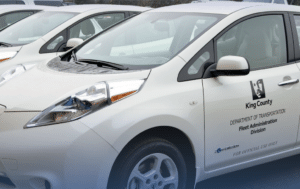 The central motor pool is part of a broader mobility strategy. Within the organization, many smaller vehicle pools still exist, each managed separately and often underutilized.
By leveraging telematics data, King County is identifying consolidation opportunities and evaluating where the shared, keyless model can be expanded further. This supports a long-term transition toward a more efficient, centralized fleet structure.
Conclusion
King County’s journey shows how a traditional motor pool can evolve into a fully flexible, future-proof mobility system.
Through a step-by-step digital transformation and a final shift to fully keyless, app-based access, the organization achieved:
- 24/7 vehicle availability
- improved fleet utilization
- reduced operational complexity
- higher user satisfaction
A transformation that not only simplifies operations, but also lays the foundation for continuous optimization and scaling.
Check out the castestudy here: Casestudy King County